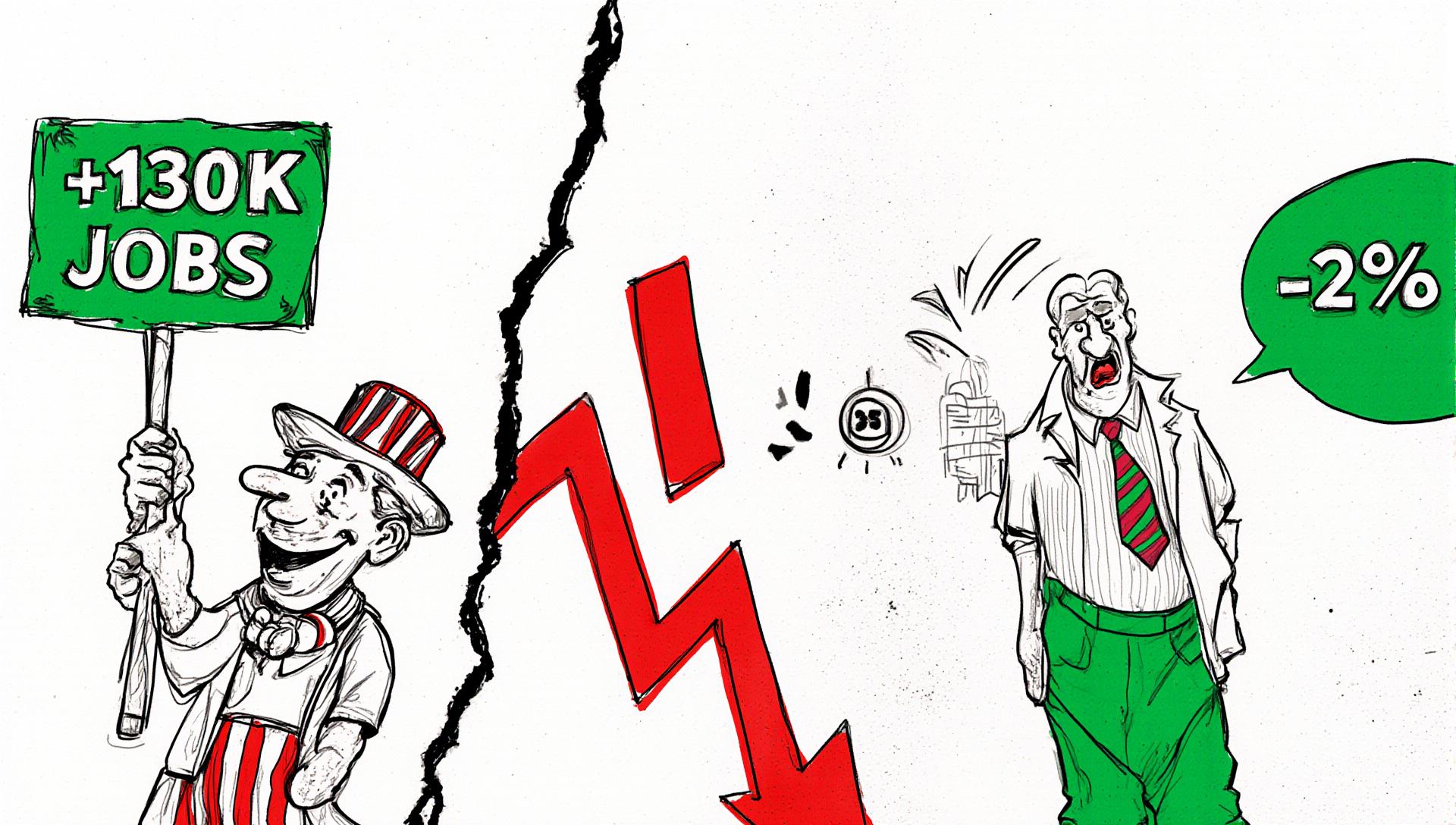
If you only read the headlines this week, the American economy looks nearly flawless. Unemployment is low. Inflation is cooling. Corporate earnings are beating expectations. By traditional macro standards, this is the soft-landing scenario policymakers dreamed of.
And yet, equity investors are staring at red screens.
The NASDAQ dropped more than 2 percent. The S&P 500 closed lower. Technology stocks absorbed another wave of selling despite an almost textbook Goldilocks economic backdrop.
This is the paradox of February 2026: a strong economy colliding with valuation reality.
Below is a structured breakdown of what is happening, why “good news” is pressuring markets, and what could reshape positioning in the week ahead.
United States: Strong Data, Weak Sentiment
On the surface, the US delivered a near-perfect macro report card.
January payrolls added 130,000 jobs — more than double expectations. The unemployment rate fell to 4.3 percent, signaling continued labor market resilience. Inflation, long the central concern, cooled further. CPI printed at 2.4 percent, its lowest reading since May 2025 and effectively within reach of the Federal Reserve’s target.
Corporate America added another positive surprise. Earnings growth is tracking at 13.2 percent, far exceeding forecasts near 8 percent. Profitability is not deteriorating. It is accelerating.
And yet equity markets sold off.
The reason lies not in growth, but in valuation.
The past three years rewarded companies that merely mentioned artificial intelligence. Capital flowed aggressively into mega-cap technology, driving valuations to historically stretched levels — 40 to 50 times earnings in some cases.
Now the market is asking harder questions.
This is not a collapse in fundamentals. It is a repricing of future expectations. Investors are scrutinizing competitive moats, capital expenditures, and long-term margin sustainability. Growth alone is no longer enough. It must justify the multiple attached to it.
This process is known as multiple compression. Even as earnings rise, the price investors are willing to pay for those earnings declines.
A key puzzle this week was the behavior of bond yields. The 10-year Treasury yield fell to 4.05 percent, its lowest level of the year. Traditionally, lower yields support high-growth technology stocks by increasing the present value of future cash flows.
But correlation failed.
The bond market appears to be pricing in safety and disinflation, while the equity market sees strong labor data as reducing the urgency for Fed rate cuts. If the economy is robust, policymakers have little reason to ease aggressively. That keeps the discount rate elevated and prolongs valuation pressure on long-duration assets.
The result is a split narrative. The economy looks solid. The market is recalibrating.
Europe: A Continent Moving at Two Speeds
European equities were relatively stable. The STOXX 600 finished nearly flat, but beneath the surface, structural divergence continues.
Fourth-quarter Eurozone GDP expanded 0.3 percent. Growth is modest but intact. However, Southern Europe — particularly Spain — is outperforming, while Germany and France struggle with industrial headwinds.
German wholesale prices rose 1.2 percent, compressing margins in manufacturing sectors already burdened by energy costs. France faces rising unemployment at 7.9 percent, nearly double US levels.
This is a two-speed Europe. The southern economies, having repaired balance sheets earlier, are more flexible. The northern industrial core is adjusting to structural cost pressures.
The UK adds another layer of complexity. The FTSE gained 0.74 percent, but political uncertainty intensified. Calls for Prime Minister resignation are increasing, creating headline risk. Yet consumer spending tells a different story. Retail sales rose 2.3 percent in January — the strongest pace since last summer — even as GDP remained nearly flat.
The British consumer appears more resilient than the political narrative suggests.
Japan: Fiscal Momentum and Market Optimism
Japan emerged as the standout performer globally. The Nikkei surged nearly 5 percent following Prime Minister Hachi’s decisive election victory.
With a supermajority secured, the government has political capital to pursue aggressive fiscal expansion, including defense spending and economic stimulus. Markets interpreted this as a green light for domestic growth acceleration.
Interestingly, the yen strengthened toward 153 per dollar rather than weakening. Investors appear to believe that sustained fiscal expansion could finally break Japan’s long-standing deflation mindset, forcing the Bank of Japan to normalize rates more aggressively.
Equities and currency rising simultaneously reflect optimism about structural change.
However, real wages remain negative, down 0.1 percent. The rally is top-down, driven by policy expectations rather than household income growth. That disconnect warrants monitoring.
China: Deflation’s Long Shadow
China remains trapped in a deflationary environment.
Producer prices have declined for 40 consecutive months — more than three years of factory-gate price contraction. CPI remains barely positive at 0.2 percent.
The property market shows tentative stabilization, with secondhand home price declines slowing, but domestic demand remains fragile. The People’s Bank of China is maintaining moderately loose policy but avoiding the kind of aggressive stimulus seen in Japan.
The risk is not immediate collapse. It is prolonged margin compression.
Chinese deflation supports global consumers by lowering goods prices, but it pressures corporate pricing power worldwide. If Chinese exports intensify, global industrial margins may compress further.
The Week Ahead: February 17–21
With US markets closed Monday for Presidents’ Day, attention shifts to the latter part of the week.
Wednesday brings the release of the Federal Reserve minutes. Investors will parse commentary for tolerance toward sticky core inflation and signals regarding rate-cut timing.
Friday is pivotal. Preliminary Q4 GDP and the PCE price index arrive together. PCE is the Fed’s preferred inflation gauge. A hotter-than-expected reading could significantly delay rate-cut expectations.
Internationally, Japan’s GDP will test whether equity optimism reflects real economic momentum. The UK releases inflation data Wednesday, clarifying whether consumer strength is feeding price pressures. China observes Lunar New Year, reducing data flow temporarily.
Top Five Risks to Watch
US growth surprise
A stronger-than-expected GDP print could eliminate near-term rate-cut hopes and intensify valuation pressure.
Sticky core inflation
Persistent inflation delays monetary easing and reshapes asset pricing across equities and real estate.
AI valuation reset
Further multiple compression in mega-cap technology could drag global indices despite solid earnings.
Japan debt issuance risk
Large-scale bond issuance to fund stimulus could spike yields and pull global capital back to Japan.
China exporting deflation
Extended factory-price declines could erode corporate pricing power globally, compressing margins.
Final Insight: Economy Versus Vibe
Corporate earnings are up 13 percent. Inflation is falling. Unemployment is low. By macro standards, this is success.
Yet portfolios are declining.
The divergence reveals something essential. Markets are no longer trading pure economic data. They are trading valuation discipline and narrative shifts.
For the past several years, investors were rewarded for betting on technological promise. Now they are being forced to evaluate price versus value.
The economy appears healthy. The mood of the market is adjusting.
Next week’s GDP and PCE releases will help determine which force dominates: the accountant’s numbers or the market’s mood ring.
FAQs
Why are stocks falling if the economy is strong?
Because valuations, particularly in technology, are compressing despite solid earnings growth.
Is this a recession signal?
No. Current data points to economic resilience, not contraction.
Why didn’t lower bond yields help tech stocks?
Because strong growth reduces urgency for Fed rate cuts, keeping discount rates elevated.
Is Japan’s rally sustainable?
It depends on whether fiscal expansion translates into real wage growth and domestic demand.
Why does China’s deflation matter globally?
It pressures global pricing power and corporate margins, even if it helps reduce consumer inflation.
Hashtags
#WeeklyMarketUpdate #StockMarket #Inflation #FederalReserve #TechStocks #AIValuation #GlobalMarkets #EconomicOutlook #JapanStimulus #ChinaDeflation #InvestmentStrategy
Subscribe to our Newsletter
Discover more