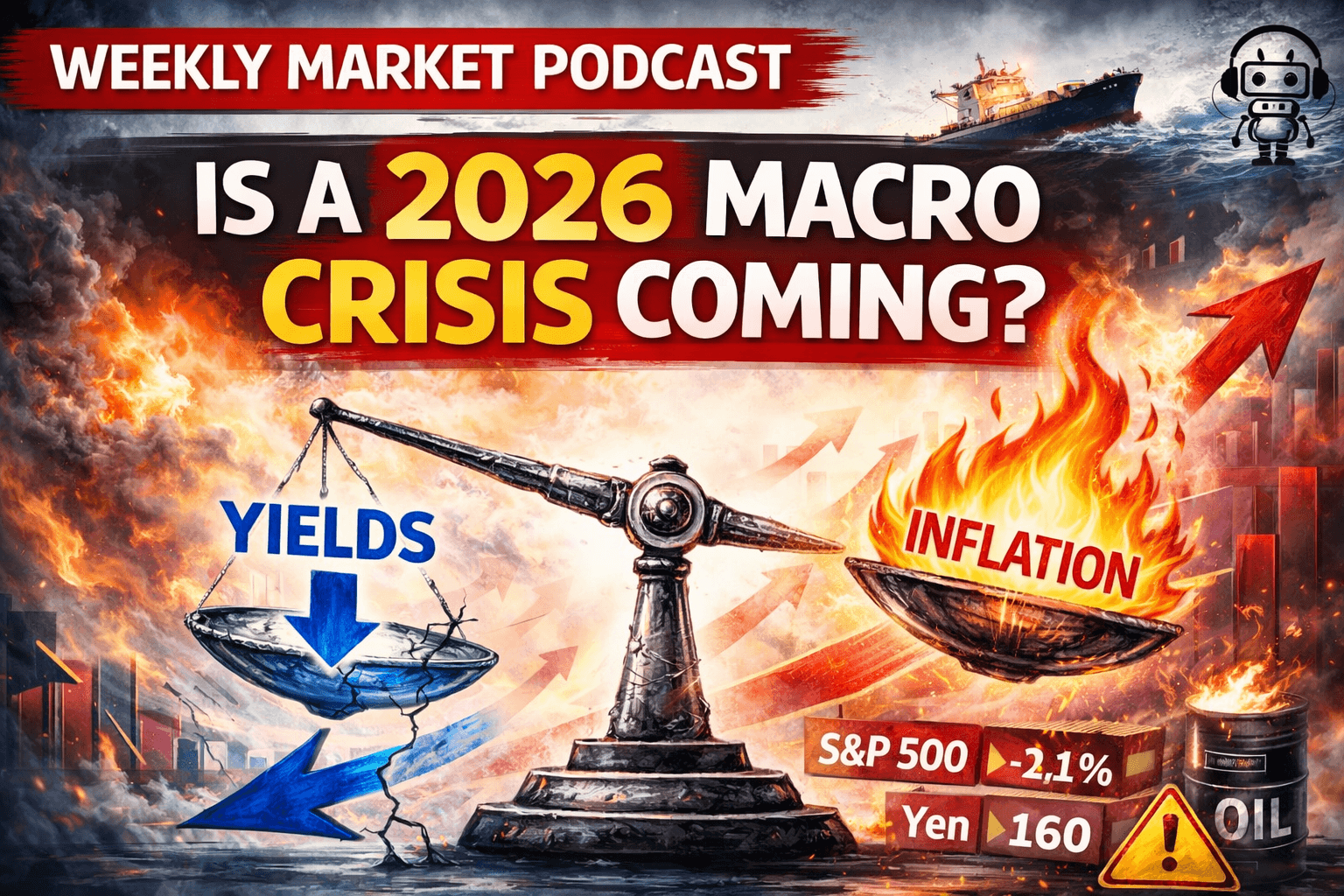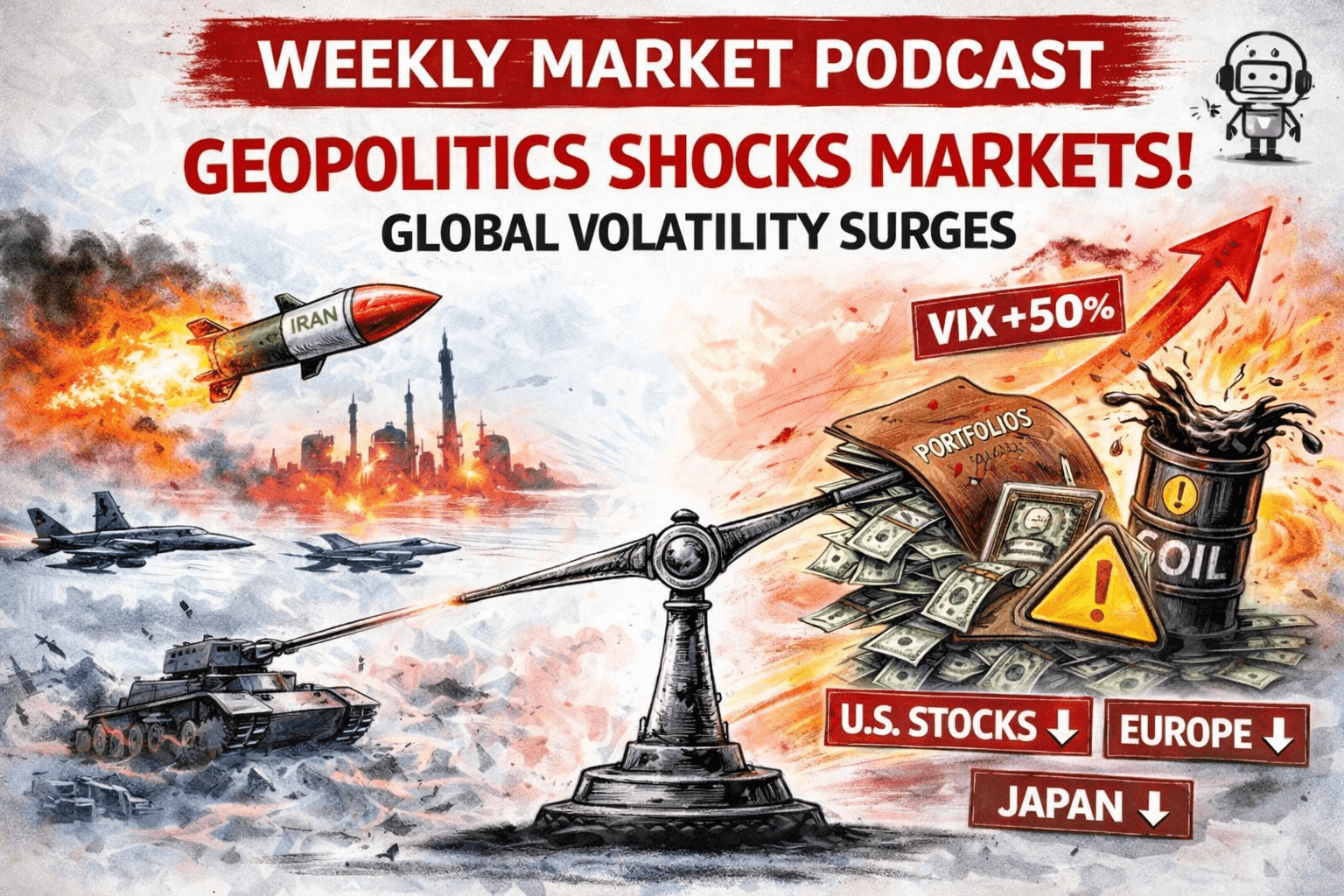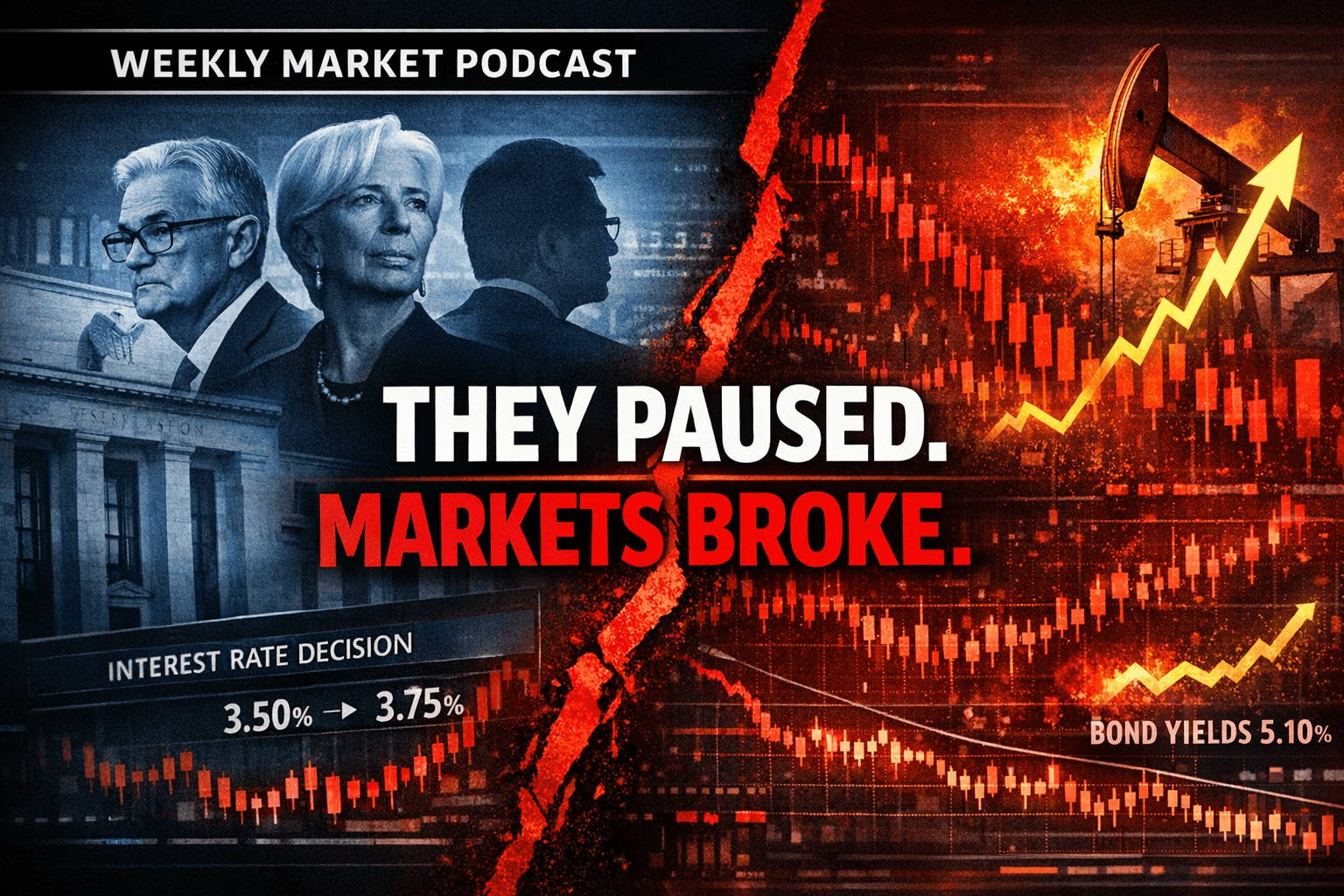
The week ending March 20, 2026 delivered one of the most counterintuitive market reactions of the year.
Every major central bank — the Federal Reserve, the ECB, the Bank of England, and the Bank of Japan — effectively did the same thing: they paused. No surprises. No shocks. A synchronized message of control.
In theory, that should have calmed markets.
Instead, it triggered a violent global repricing.
Equities sold off sharply, bond yields surged, and investors suddenly realized they had been preparing for the wrong kind of inflation. The narrative didn’t just shift — it broke. What had been a demand-driven inflation story has now been overtaken by something far more dangerous: a supply shock, driven by geopolitics and energy.
This is not a continuation of the old cycle. It is a regime shift.
The Real Shift: From Demand Inflation to Supply Shock
For the past year, markets were anchored around a comforting assumption: inflation was fading. Central banks had done their job, demand was cooling, and a soft landing was achievable.
That assumption is now under threat.
The fear is no longer about consumers spending too much. It is about supply constraints — specifically energy — pushing prices higher regardless of demand conditions.
This distinction matters enormously.
Demand-driven inflation can be managed with interest rates. Supply shocks cannot. Central banks cannot print oil. They can only suppress demand enough to offset the shock — often at the cost of growth.
That realization is what triggered the selloff.
United States: Inflation Pressure Meets a Consumer Wall
US markets struggled across the board. The S&P 500 fell 1.9%, the NASDAQ dropped over 2%, and the Dow declined 2.11%. Energy stocks were the only clear winners.
The Federal Reserve held rates at 3.50–3.75%, but the accompanying data told a very different story.
Producer prices (PPI) rose 0.7% month-over-month and 3.4% year-over-year — a clear sign that pipeline inflation remains alive. At the same time, new home sales collapsed to their lowest level since 2022.
This is the core contradiction shaping the US outlook.
On one side, inflation pressures are reaccelerating, driven in part by energy. On the other, the consumer is hitting affordability limits, particularly in interest-rate-sensitive sectors like housing.
The result is a tightening vice:
Inflation is too high for the Fed to ease aggressively
Growth is too fragile to withstand further tightening
This is where policy risk becomes acute. If the Fed cuts too early, it risks reigniting inflation — a replay of the 1970s policy mistake. If it stays restrictive, it risks deepening the slowdown.
The margin for error is shrinking fast.
Europe: A Structural Energy Problem Turns Into Stagflation Risk
If the US faces a policy dilemma, Europe faces a structural one.
European equities sold off sharply, with the DAX down 4.55% and the STOXX 600 falling 3.79%. The ECB held rates but raised its 2026 inflation forecast to 2.6% and warned of the “material impact” of rising energy prices.
This is where Europe’s vulnerability becomes clear.
Unlike the US, Europe imports the majority of its energy. When oil prices spike, the impact is immediate and concentrated in its industrial core — particularly in sectors like chemicals and machinery.
At the same time, external demand is weakening. The Eurozone trade balance deteriorated further, exposing fragility in export-driven industries.
The result is a classic stagflation setup:
Weak industrial activity
Rising input costs
Persistent inflation pressure
Even though backward-looking data, like German producer prices, still show disinflation, markets are focused on forward expectations. Companies hedge future energy costs, not past ones. And right now, those expectations are deteriorating rapidly.
United Kingdom: Growth Squeezed, Liquidity Tightened
The UK sits at the intersection of these pressures.
The FTSE 100 fell 3.34%, while the Bank of England held rates at 3.75% and warned of renewed inflation risks from energy. At the same time, domestic demand is weakening, as highlighted by declining manufacturing orders.
What makes the UK particularly fragile is the interaction between monetary policy and financial regulation.
New proposals from the Prudential Regulation Authority (PRA) are pushing banks to hold larger liquidity buffers. In isolation, that improves financial stability. But in the current environment, it has a side effect: it restricts credit just as businesses are facing rising costs.
This creates a dangerous combination:
Weak demand
Rising costs
Tightening credit conditions
The UK economy is effectively being squeezed from both sides, with very little room to absorb external shocks.
Japan: When a Weak Currency Becomes a Liability
Japan’s market reaction was more muted, with the Nikkei down just 0.83%, but the underlying dynamics are increasingly fragile.
The yen strengthened slightly to around 159 per dollar, but remains historically weak. At the same time, oil prices are rising — a dangerous combination for an economy that imports most of its energy.
This is where the concept of terms of trade becomes critical.
A weak currency boosts exports, but it also makes imports — especially energy — significantly more expensive. When oil prices rise, the negative effect dominates.
Japan is now facing imported inflation that acts as a tax on both businesses and consumers. This complicates the Bank of Japan’s normalization path. Raising rates to stabilize the currency risks slowing growth. Keeping rates low risks amplifying inflation.
Japan’s policy trajectory is now closely tied to global energy markets.
China: Growth Data Improves, But Geopolitics Caps the Upside
China delivered relatively strong economic data this week:
Industrial production: +6.3%
Retail sales: +2.8%
Fixed asset investment: +1.8%
There were also early signs of stabilization in the property sector.
Yet markets declined, with the Shanghai Composite down 3.38% and the CSI 300 down 2.19%.
The reason is simple: geopolitics is overriding domestic fundamentals.
The reemergence of US trade tensions, particularly through potential Section 301 investigations, has raised the risk of new tariffs and restrictions. For investors, this acts as a ceiling on China’s recovery.
Even if domestic data improves, external constraints limit the upside.
China is stabilizing internally, but remains vulnerable externally.
The Week Ahead: March 23–27
The coming week is critical for validating — or breaking — the current narrative.
In the United States, attention will focus on consumer sentiment, productivity, and import/export prices. These will provide insight into how inflation is affecting both households and corporate margins.
In Europe, German flash PMIs will be key. A contraction in the industrial core would reinforce stagflation fears.
In the UK, inflation data will determine whether the Bank of England can maintain its current stance or is forced back into tightening rhetoric.
In Japan, inflation data will shape expectations around policy normalization.
Among all these releases, German PMIs stand out as the most important. A weak reading would confirm that Europe’s industrial engine is stalling under energy pressure — a development with global implications.
Top Five Risks to Watch
1. Energy-driven inflation resurgence
A sustained oil shock forces central banks to remain restrictive, weighing on global equities.
2. Fed rate cut expectations fading
Stronger inflation data could eliminate remaining expectations for easing, tightening financial conditions.
3. European stagflation dynamics
Weak growth combined with rising costs traps the ECB in a difficult policy position.
4. UK inflation surprise
A higher-than-expected print would pressure both bonds and equities simultaneously.
5. China trade tensions escalation
New tariffs or restrictions could derail the recovery despite improving domestic data.
Final Thought: Who Really Controls the Cycle?
This week delivered a sobering message.
Central banks can pause. They can guide expectations. They can manage demand.
But they cannot control geopolitics.
When energy markets move on geopolitical shocks, inflation expectations shift instantly — and with them, the entire macro framework. The synchronized pause we saw this week did not restore confidence. It exposed a deeper truth: monetary policy is no longer the dominant force in markets.
The question now is not whether inflation is under control.
It is whether central banks still control the cycle at all.
FAQs
Why did markets fall despite central banks pausing?
Because the focus shifted from demand-driven inflation to supply shocks driven by energy and geopolitics.
Why is energy so critical right now?
Because it feeds directly into inflation and cannot be controlled by monetary policy.
Why is Europe more vulnerable than the US?
Due to its heavy reliance on imported energy and industrial exposure.
Why didn’t China’s strong data support markets?
Because geopolitical trade risks are limiting investor confidence.
What is the key risk next week?
Confirmation of stagflation signals, particularly in European industrial data.
Hashtags
#WeeklyMarketUpdate #GlobalMarkets #Inflation #EnergyShock #CentralBanks #FederalReserve #ECB #BankOfEngland #JapanEconomy #ChinaMarkets #MacroOutlook #InvestmentStrategy
Subscribe to our Newsletter
Discover more