This was the week global markets stopped listening to economic data and started listening almost exclusively to central bankers. Capital flows over the past five trading days point to something more than short-term volatility — they suggest a structural shift in how investors are positioning across regions.
What stood out was not just market movement, but divergence. The United States delivered the long-awaited rate cut, Europe openly resisted easing despite slowing growth, and Asia moved in two opposite directions, with Japan preparing to tighten while China remains trapped in deflationary pressure.
Monetary policy is no longer unified. It is fragmented, region-specific, and increasingly political. Understanding this shift is now essential for navigating markets into year-end and beyond.
This update breaks down what happened in the US, Europe and the UK, Japan, and China — and identifies the five critical landmines investors need to understand before the calendar turns.
United States: A Rate Cut That Split the Fed and the Market
For the week ending December 12, US equity markets spoke in two very different languages. On the surface, the headline indices suggested resilience. Beneath the surface, capital rotated aggressively in response to policy mechanics.
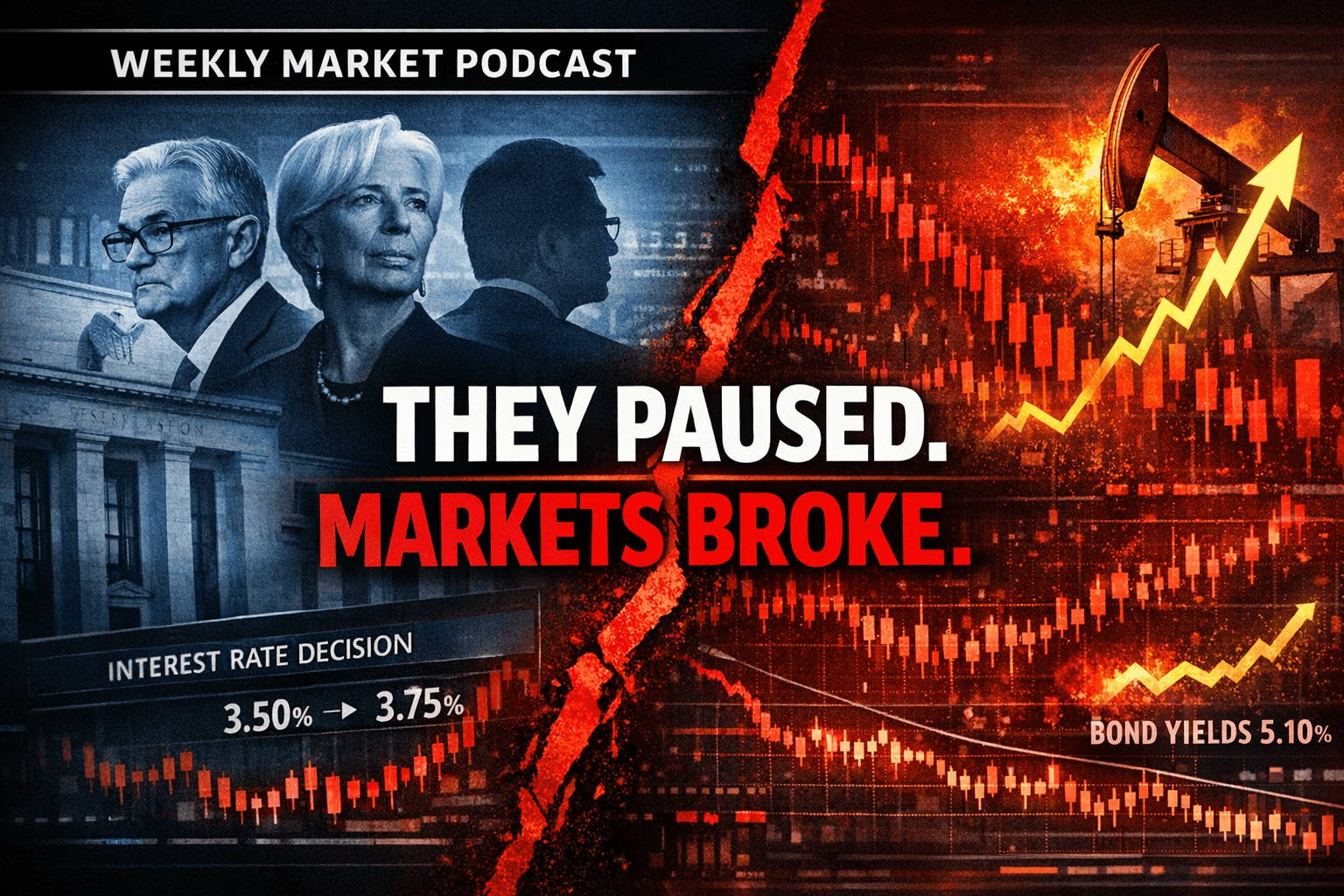
The Dow Jones rose 1.05%, and the Russell 2000 gained 1.19%, with both reaching fresh highs. Small caps and cyclicals clearly benefited from the Federal Reserve’s long-awaited 25 basis point rate cut, which brought the policy rate into the 3.5%–3.75% range.
At the same time, mega-cap growth struggled. The Nasdaq fell 1.62%, and the S&P 500 ended the week lower. This split was not accidental — it was a direct reaction to how the rate cut was delivered.
For the first time in six years, three Fed policymakers dissented against the decision. That dissent matters. It signals deep internal disagreement about the 2026 outlook, not about current inflation, but about the risks of declaring victory too early and reigniting asset bubbles in housing and credit.
Markets had priced in a smooth, consensus-driven easing path. The dissent shattered that assumption. Capital immediately rotated toward sectors that benefit most directly from cheaper financing — small caps, financials, and value stocks — while high-multiple growth names lost favor.
This rotation was reinforced by cooling macro signals. Jobless claims jumped unexpectedly to 236,000, the highest level since September. Even more telling, the number of workers voluntarily quitting their jobs fell to a post-2020 low, a clear sign of declining worker confidence and easing labor market pressure.
Commodity markets echoed the same story. US crude oil fell more than 4%, closing near $57.40 per barrel, reinforcing the disinflationary narrative that gave the Fed political cover to cut.
The takeaway from the US is clear: this was not a growth rally. It was a policy-driven reallocation — and it came with visible internal stress at the Fed.
Europe and the UK: Resisting Easing as Growth Cracks
Across the Atlantic, the contrast could not have been sharper. While the Fed eased under internal pressure, the European Central Bank actively fought market expectations of rate cuts.
European equity markets were mixed. The STOXX Europe 600 edged lower, while Germany’s DAX managed a small gain. The real story, however, was messaging.
Key ECB figures delivered a coordinated hawkish signal. Isabel Schnabel openly discussed the possibility of future rate hikes, and President Lagarde hinted at potential growth upgrades. This was deliberate language designed to anchor expectations and push back against premature easing.
The ECB’s priority remains clear: avoid a re-acceleration of inflation at almost any cost. Growth concerns, for now, are secondary.
That stance stands in stark contrast to economic reality, especially in the UK. Britain’s economy appears to be sliding toward technical recession. GDP contracted for a second consecutive month, with October shrinking by 0.1% following a similar decline in September. Even more concerning, services output — the backbone of the UK economy — fell 0.3%.
Housing and consumer confidence are weakening. The latest RICS survey showed homebuyer demand at a two-year low. Yet the Bank of England remains trapped by inflation fears, reluctant to ease policy even as growth deteriorates.
Europe, in effect, is driving with one foot on the brake — resisting easing while hoping not to stall the economy entirely.
Asia: Policy Paths Split Wide Open
Asia delivered the clearest evidence that global monetary policy is no longer synchronized.
Japan: Tightening Into Contraction
Japan is preparing for a historic shift. All economists surveyed now expect the Bank of Japan to raise rates to 0.75% next week, ending a defining era of ultra-loose policy.
Governor Ueda has signaled confidence in domestic wage growth and pricing power — the long-missing ingredients that once justified extreme easing. With inflation now entrenched, the BoJ feels compelled to act.
The paradox is striking. Japan is tightening into a contracting economy. Q3 GDP was revised down sharply to an annualized -2.3%. Household spending is fragile, and consumer confidence remains weak.
This is not a cyclical decision. It is a structural one. Japan is prioritizing currency stability and long-term inflation normalization over near-term growth. How the BoJ communicates this move will determine whether markets interpret it as the start of a full tightening cycle or a symbolic adjustment.
China: Deflation Tightens Its Grip
China faces the opposite problem. Mainland equities slipped, with the CSI 300 slightly lower, as deflationary pressure deepened.
Headline CPI rose just 0.7% year over year, while core inflation remained stuck at 1.2%. The most alarming signal came from producer prices. China’s PPI fell 2.2%, marking the 38th consecutive month of decline.
That matters because falling producer prices indicate a complete lack of pricing power. Companies are forced to discount, margins compress, investment slows, and demand weakens further. This deflationary feedback loop is extremely difficult to break.
Despite Beijing’s rhetoric against destructive price wars, policy measures have yet to reverse the trend. China’s inflation recovery remains elusive, complicating any effort to stimulate demand heading into 2026.
The Week Ahead: December 15–19, 2025
The coming week is a macro pressure cooker, combining central bank decisions with delayed US data.
United States
Tuesday: Delayed October–November jobs and unemployment data, plus November retail sales
Thursday: CPI inflation report
Friday: University of Michigan consumer sentiment
Europe and UK
Thursday: ECB rate decision and press conference
Thursday: Bank of England rate decision
Japan
Monday: Tankan survey
Friday: Bank of Japan rate decision and inflation data
China
Key economic data releases throughout the week, including retail sales and industrial production
This calendar has the power to reset positioning for the next quarter.
Top Five Risks to Watch
US inflation surprise
A sticky CPI print could force a sharp repricing of Fed cut expectations and hit rate-sensitive assets.ECB hawkish escalation
Any aggressive hint at future hikes would rattle Eurozone bond and equity markets.Bank of Japan policy execution
The tone, guidance, and framing of Japan’s expected rate hike will dictate global capital flows.China’s chronic demand weakness
Disappointing retail or industrial data would revive deflation fears and pressure commodities and EM assets.UK recession confirmation
A third consecutive GDP contraction would confirm recession and intensify political pressure on the Bank of England.
Final Insight: A Multipolar Monetary Regime Is Here
Monetary policy is firmly back in the driver’s seat — but it is pulling markets in different directions. The US is easing under internal tension. Europe is resisting despite weakening growth. Japan is tightening into contraction. China is struggling to escape deflation.
This fragmentation creates both risk and opportunity. The surge in US small caps alongside weakness in mega-cap tech raises a critical question: are we witnessing the start of a multi-year leadership shift driven by policy normalization, or was this simply a tactical rotation?
That question now hangs over every portfolio.
Frequently Asked Questions
Why did US small caps outperform while tech declined?
Because cheaper money directly benefits rate-sensitive sectors, while Fed dissent raised doubts about long-term growth valuations.
Why does Fed dissent matter if rates were cut anyway?
It signals deep disagreement about the future path of policy, increasing uncertainty and volatility.
Why is the ECB resisting easing despite weak growth?
The ECB prioritizes inflation credibility and fears repeating past mistakes of easing too early.
Why is Japan tightening despite negative GDP growth?
The BoJ is responding to structural wage and inflation dynamics, not short-term growth.
Why is China’s falling PPI such a serious problem?
It reflects persistent deflation, collapsing pricing power, and weakening domestic demand.
Hashtags
#WeeklyMarketUpdate #GlobalMarkets #FederalReserve #FOMC #ECB #BankOfJapan #MonetaryPolicy #InterestRates #Inflation #Deflation #ChinaEconomy #JapanRates #UKRecession #MarketRotation #InvestmentStrategy #MacroAnalysis
Subscribe to our Newsletter
Discover more