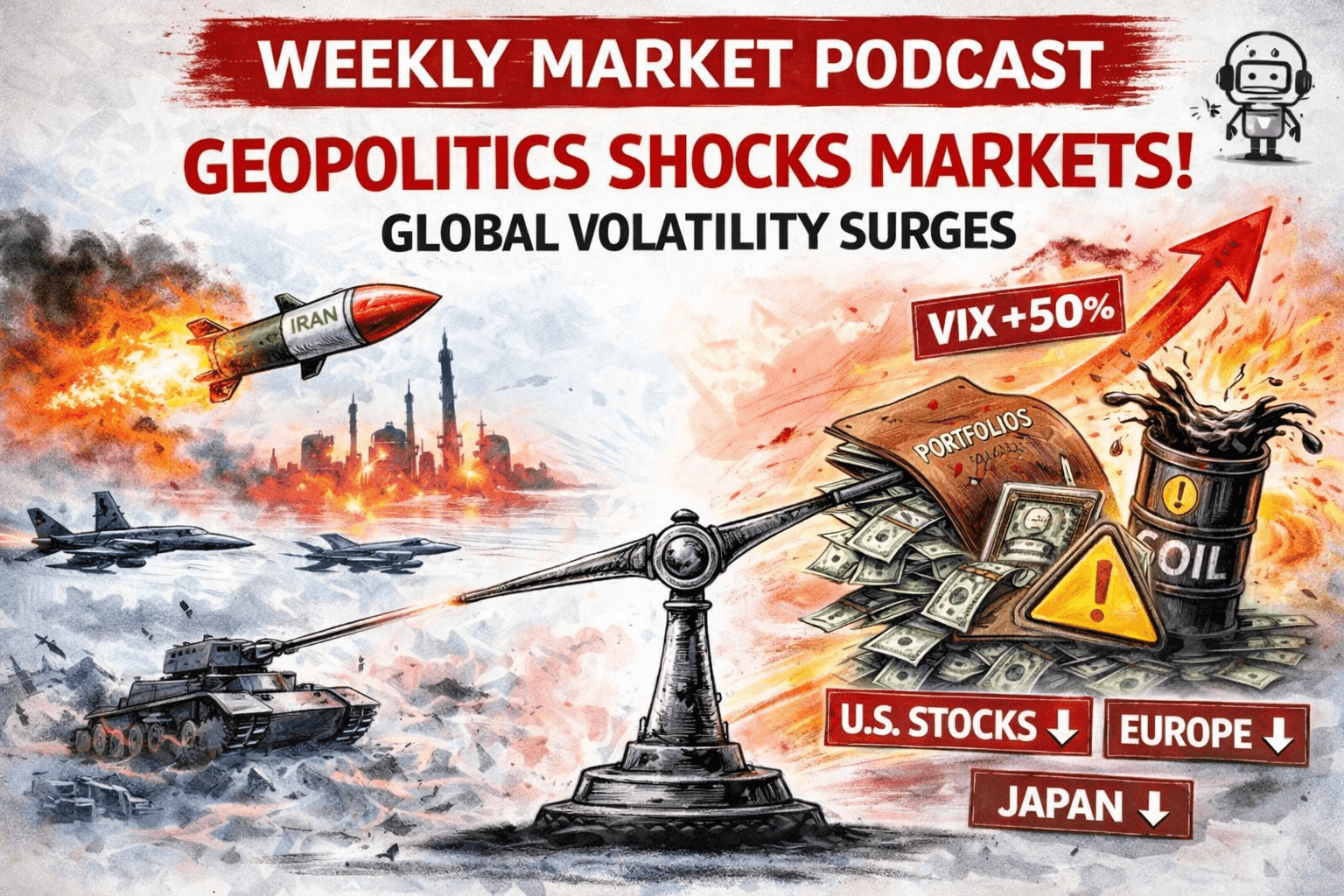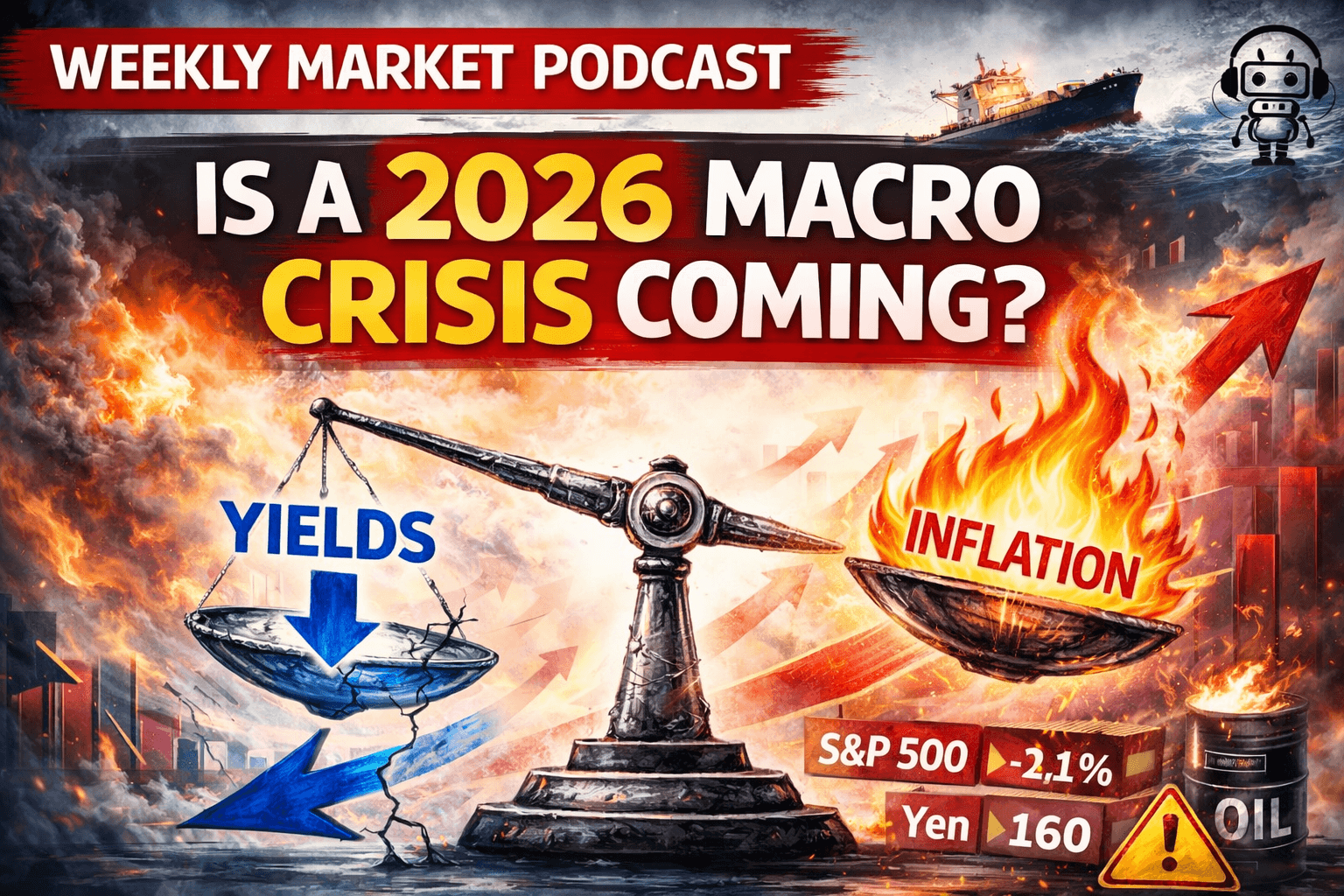
If February ended in confusion, the week ending March 13, 2026 delivered something even more dangerous: a full-blown market stress test. In just five trading days, crude oil swung from roughly $119 a barrel to below $77, then snapped back to settle near $98. That is not ordinary volatility. That is the kind of price action that forces global investors to question whether the old macro playbook still works at all.
This was not simply an energy story. The oil shock collided directly with two pre-existing problems that were already destabilizing global portfolios: sticky inflation and rapidly slowing growth. The result was a week in which equities sold off, bond yields turned violent, currencies cracked, and central banks found themselves trapped between inflation they cannot ignore and growth they cannot afford to crush.
The core theme is systemic stress. The United States is slipping into a stagflationary bind, Europe’s industrial core is absorbing an energy shock it cannot control, Japan is caught in a currency-energy doom loop, and China is trying to build a fortress economy while much of the world stumbles.
Below is a structured breakdown of what mattered, what didn’t, and what could reshape markets in the week ahead.
United States: Slowing Growth, Sticky Inflation
Wall Street did not handle the oil shock well. The S&P 500 fell 1.6 percent, the NASDAQ lost 1.3 percent, and the Dow dropped 2.0 percent. But the deeper damage was in the small-cap universe: the Russell 2000 plunged 4.0 percent, reflecting just how vulnerable smaller firms are when borrowing costs move sharply higher.
The 10-year Treasury yield climbed from 3.96 percent to 4.28 percent, a major move in the bond market. At the same time, the VIX settled near 27.2, signaling that institutional investors were paying heavily for downside protection. When both yields and volatility rise together, it tells you markets are no longer debating soft-landing probabilities. They are pricing stress.
The domestic macro data made the situation even more unstable. Fourth-quarter GDP was revised down to just 0.7 percent annualized, a dramatic slowdown from the 4.4 percent pace in the prior quarter. Yet inflation is not cooling. Core PCE climbed to 3.1 percent, the highest since early 2024.
That combination is toxic. Weak growth normally gives the Federal Reserve space to cut. But inflation at 3.1 percent blocks that route. The Fed is stuck in a classic stagflationary drag: growth is slipping, but energy and services inflation remain too high to justify easy policy.
The labor market added another layer of contradiction. Payrolls contracted by 92,000 in February and unemployment rose to 4.4 percent, yet both services and manufacturing PMIs remained in expansion territory. Services PMI came in at 56.1 and manufacturing at 52.4. That suggests businesses are maintaining output through efficiency gains and prior investment, even as they freeze hiring and cut labor in anticipation of future weakness.
The US is not collapsing. But it is becoming harder to stabilize.
Europe and the United Kingdom: Imported Inflation, Industrial Damage
Europe took the oil shock far worse than the US. Germany’s DAX fell 6.7 percent, France’s CAC 40 lost 6.84 percent, Italy’s FTSE MIB dropped 6.48 percent, and the STOXX Europe 600 slid 5.55 percent.
The explanation is structural. Europe imports a far greater share of its energy needs, so a violent oil move translates directly into industrial pain. German factory orders collapsed 11.1 percent month over month, while Eurozone industrial production fell 1.5 percent, the worst decline since April 2025.
At the same time, Eurozone CPI surprised to the upside at 1.9 percent, while unemployment hit a record low of 6.1 percent. That sounds positive at first glance, but it is actually part of the stagflation trap. A tight labor market supports wage pressure just as energy costs are rising, even while growth is stagnating.
This is why markets started to price the uncomfortable possibility of an ECB hike into a weakening economy. Europe is being forced to absorb imported inflation without the domestic growth needed to offset it.
The UK was caught in a similarly fragile position. The FTSE 100 dropped 5.74 percent and sterling fell to its weakest level since December. Construction PMI slowed sharply, while Halifax house prices still rose 1.3 percent year over year — a reminder that housing often lags macro deterioration. More important was the warning from the Office for Budget Responsibility, which explicitly said the Middle East conflict could have “very significant impacts” on the economy. That is unusually strong language from an official body, and markets noticed.
Japan: The Currency-Energy Doom Loop
Japan experienced one of the most mechanically dangerous setups of the week. The Nikkei fell 5.49 percent and the TOPIX lost 5.63 percent, while the yen weakened to 159.5 per dollar.
That combination matters enormously because Japan imports most of its energy and pays for it in dollars. When crude rises sharply and the yen simultaneously weakens, the cost of energy in local terms explodes. Japanese firms are hit twice: once by global price increases, and again by currency depreciation.
This is the currency-energy doom loop.
At the same time, Japanese labor unions are demanding 6 percent wage increases, a startling number in a country with a long deflationary history. So imported inflation is now colliding with domestic wage pressure. The Bank of Japan is being pushed toward tighter policy, but doing so in the middle of a global energy shock could destabilize growth and trigger a broader unwind of carry trades worldwide.
This is why Japan matters far beyond Japan. It is a global liquidity question, not just a domestic macro one.
China: Relative Resilience, Strategic Targeting
In a week when most global markets were hit hard, Chinese equities showed relative resilience. The CSI 300 fell just 1.07 percent, the Shanghai Composite lost 0.93 percent, and the Hang Seng dropped 3.28 percent.
That stability reflects a deeper policy pivot. China has set a 2026 GDP target of 4.5 to 5 percent, its lowest in decades. Rather than pushing for headline growth through indiscriminate real estate or infrastructure stimulus, Beijing is focusing on targeted areas such as advanced manufacturing, self-sufficiency, and strategic industrial capacity.
Authorities announced 800 billion yuan in new investment financing and 4.4 trillion yuan in special local-government bond issuance. The point is not to inflate everything. It is to reinforce specific sectors.
The PMI split captures the transition clearly. The official PMI, dominated by large state-owned industrial firms, remained in contraction at 49.0. But the Caixin PMI, which tracks smaller, more agile private firms, rose to 52.1. China’s old industrial model is softening, but its export-oriented and technology-linked segments remain resilient.
This is no longer a “buy China” story. It is a sector-selection story.
The Week Ahead: March 16–20
The coming week is one of the most important of the quarter because it combines central-bank decisions with inflation-sensitive data.
The main event is the central-bank gauntlet across March 18–19. Within roughly 48 hours, markets will have to absorb policy decisions from the Federal Reserve, the ECB, the Bank of England, and the Bank of Japan. That alone is enough to drive major volatility.
In the US, the PPI release will be closely watched as a signal of whether inflation pressure remains hot at the wholesale level. For markets, that matters because producer inflation often shows up later in consumer prices. If PPI reinforces the recent rise in core PCE, investors may finally abandon hopes for Fed easing in 2026.
In Europe, the German ZEW Economic Sentiment Index will be critical. After the collapse in factory orders, investors need to know whether industrial pessimism is spreading deeper into business expectations.
China will also be in focus, with January–February industrial production and retail sales. Those numbers will help answer the question raised this week: is domestic demand finally waking up, or is China still relying almost entirely on export strength?
Top Five Risks to Watch
Oil supply shock escalation
Any renewed disruption through the Strait of Hormuz could push crude back above $100 and overwhelm every other macro narrative.
US inflation surprise
If PPI confirms sticky pipeline inflation, markets may fully price out any meaningful Fed cuts for the year.
US labor market deterioration
The February payroll decline may not have been a one-off. More weakness would accelerate recession fears.
Japanese currency intervention
A sudden move to defend the yen could trigger global liquidity stress through carry-trade unwinds.
China growth execution risk
If targeted stimulus fails to support the weaker sectors of the Chinese economy, emerging markets and global commodities could come under renewed pressure.
Final Insight: A Shock Without a Hedge
This week exposed something deeper than a temporary geopolitical scare. It showed how little protection traditional diversification offers when inflation, energy, currencies, and growth all move together.
When oil surges, inflation expectations rise, yields jump, equities fall, and central banks freeze — all at once. In that environment, the traditional 60/40 portfolio is not automatically a hedge. Both stocks and bonds can be hit by the same shock, for the same reason, at the same time.
That is the real lesson of the week ending March 13. The old assumptions about diversification are being tested in real time. And if geopolitical energy shocks become a recurring feature of the global system, investors may need to rethink not just their macro outlook, but the entire architecture of portfolio protection.
FAQs
Why did oil matter so much this week?
Because energy is an input into nearly every part of the economy. A move of this size instantly affects inflation, margins, and policy expectations.
Why did small-cap US stocks fall more than large caps?
Because smaller firms are much more exposed to higher borrowing costs and refinancing pressure.
Why was Europe hit harder than the US?
Because Europe is more dependent on imported energy, making it more vulnerable to oil shocks.
Why does the yen matter globally?
Because it underpins the carry trade. Sharp moves can force liquidations across many unrelated assets worldwide.
What matters most next week?
The central-bank decisions on March 18–19, plus any data that confirms inflation is staying sticky.
Hashtags
#WeeklyMarketUpdate #GlobalMarkets #OilShock #Inflation #FederalReserve #ECB #BankOfJapan #ChinaEconomy #MarketVolatility #InvestmentStrategy #MacroOutlook
Subscribe to our Newsletter
Discover more